
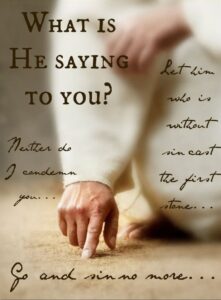
 シモンという男がイエスの足元に膝まづく一人の女を前にして「この罪の女!」と心に思った。その心を知るイエスは毅然と彼に言われた「シモン、あなたに言うことがある」。
シモンには知らないことが二つあった。一つ、彼はこの女のことを何も知らない。彼女がその日にいたった人生の旅路を一切、知らない。「この罪の女!」、そんな一言で人の一生を説明することなど、誰にもできない。
もう一つ、彼が知らなかったこと、それは神の前に自分も「罪の男」だったということ・・・。
本日の「礼拝映像」「ポッドキャスト」「一日一生」はこちらから。
↓ 今日の「日英礼拝メッセージ原稿」「おもちかえり」はこちらから ↓
新しい出発(9):イエス曰く、「あなたに言うことがある」
2022年5月1日
今日のテキストになりますルカ7章36節―50節を拝読させていただきます。
36あるパリサイ人がイエスに、食事を共にしたいと申し出たので、そのパリサイ人の家にはいって食卓に着かれた。37するとその時、その町で罪の女であったものが、パリサイ人の家で食卓に着いておられることを聞いて、香油が入れてある石膏の壷を持ってきて、38泣きながらイエスのうしろでその足もとに寄り、まず涙でイエスの足をぬらし、自分の髪の毛でぬぐい、そして、その足に接吻して、香油を塗った。39イエスを招いたパリサイ人がそれを見て、心の中で言った、「もしこの人が預言者であるなら、自分にさわっている女が誰だか、どんな女か分かるはずだ。それは罪の女なのだから」。40そこでイエスは彼に向かって言われた、「シモン、あなたに言うことがある」。彼は「先生、おっしゃってください」と言った。41 イエスが言われた、「ある金貸しに金をかりた人がふたりいたが、ひとりは五百デナリ、もうひとりは五十デナリを借りていた。42 ところが、返すことができなかったので、彼はふたり共ゆるしてやった。このふたりのうちで、どちらが彼を多く愛するだろうか」。43 シモンが答えて言った、「多くゆるしてもらったほうだと思います」。イエスが言われた、「あなたの判断は正しい」。44 それから女の方に振り向いて、シモンに言われた、「この女を見ないか。わたしがあなたの家にはいってきた時に、あなたは足を洗う水をくれなかった。ところが、この女は涙でわたしの足をぬらし、髪の毛でふいてくれた。45 あなたはわたしに接吻をしてくれなかったが、彼女はわたしが家にはいった時から、わたしの足に接吻をしてやまなかった。46 あなたはわたしの頭に油を塗ってくれなかったが、彼女はわたしの足に香油を塗ってくれた。47 それであなたに言うが、この女は多く愛したから、その多くの罪はゆるされているのである。少しだけゆるされた者は、少しだけしか愛さない」。48 そして女に、「あなたの罪はゆるされた」と言われた。49 すると同席の者たちが心の中で言いはじめた、「罪をゆるすことさえするこの人は、いったい、何者だろう」。50 しかし、イエスは女にむかって言われた、「あなたの信仰があなたを救ったのです。安心して行きなさい」。
宗教改革をなしたマルチンルターは、この聖書箇所をとても愛したと言われています。そして、彼は自分が愛するだけではなく、人々に毎年一回はこの記事を読み、ここからのメッセージをしなくてはいけないと言いました。
それはキリスト者、あるいは教会が毎年一回はこの物語に戻り、この物語を思い巡らし、必要なら自分の考えを修正することが大切だということです。ルターがそれほどまで言うこの出来事はどんな話なのでしょうか。今日はまず第一に「あなたは彼女のことを知っているのか」ということをお話しします。
一人の登場人物が現れます。彼女は女性であり、ここにはその名前すら記されていません。ただ、こう記されています。「彼女はその町で罪の女であった」。彼女はなぜ罪の女だと言われていたのでしょうか。
このように彼女が呼ばれていたということに対して、その細かなことは書かれていませんが、注解書や当時の時代背景から分かることは、おそらく彼女が自らの体を売りながら生きていたということではないかと思われます。そして、その彼女の様は人が彼女を一目見て「あの女は罪の女だ」と分かるような女性であったということです。
その時、イエス様はパリサイ人に招かれて、シモンという人の家の食卓についていました。
イエス・キリストは、招かれる食事にはそれが誰からのものであっても断ることなく、出来る限り出向いていったようです。今回のようにパリサイ派の人というような宗教家、また取税人や遊女罪人というようないわゆる町のアウトサイダーとの食卓にもイエス様は同席されました。
その時、イエス様の前には美味しそうな食事が運ばていたことでしょう。その時、足元に黒い影が近づいてきて、イエスの足元にひざまずきました。誰だろうかと思いきや、そこには瞳に涙を貯めた女性がおり、その目から流れる涙で彼女はイエスの足を濡らしました。そして、その髪の毛でその足を拭き、その足に口づけをして、香油を塗り始めたというのです。
当時は家の扉を開け放して食事をすることがよくあったといいます。故に彼女は家の中に入ることができたようです。彼女は給仕する女性たちにまぎれ混んでいたのかもしれません。
パリサイ人は厳格な人達で女性と町で話しをすることはありませんでしたし、ましてや食事を共にするということはありえませんでした。彼らの信条は汚れたもの、罪ある者と自らを隔離することによって、自らのきよさを保つというものでしたから、この罪の女性が自宅の、しかも食事の席に近づいているということは許しがたいことでした。この女性も、もちろんそんなことは知っていたでしょう。自分は今、居てはいけない場所にいるということを。そして、そのことによって、どんな罵声と非難を浴びるかということを。
実際に「どこから入ってきたんだ!ここは、お前みたいな汚れた女が来る所じゃない!律法の書にはお前のような人間は、その人だけではなくて、三代、四代まで罰が下されると書かれているぞ」というような言葉を受けたということは十分、考えられます。
このように浴びせられた言葉は彼女が初めて聞く言葉ではなかったことでしょう。そんな言葉を彼女はいつも受け止めてこれまで生きてきたことでしょう。
おそらく彼女はこの出来事の前にイエス様にお会いしていたのではないかと思われます。何度かイエス様の話を聞き、好奇心と侮辱で満ちた眼差しを彼女に送っていた人達とは異なるイエス様のお心というものを感じ取っていたのかもしれません。
もしかしたらイエスが言われた「私のもとに来なさい、あなたがたを休ませてあげます」(マタイ11章28節)というような言葉も聞いていたのかもしれません。
彼女はこの人なら自分の現状を変えてくださるかもしれないと、勇気を振り絞ってそこにやってきたのです。この一部始終を見ていたこの家の主人、シモンは心の中でこう言いました。
「もしこの人が預言者であるなら、自分にさわっている女が誰だか、どんな女か分かるはずだ。それは罪の女なのだから」(39)。
この言葉は言い方を変えれば「俺はこの女がどんな女だかよく分かっている」ということを意味します。そして、じゃーどんな女なのかといえば「彼女は罪の女なのだ」ということになります。
私達はこの箇所を「そうだろうな。彼女は一目見て罪人と分かる女性だったんだろうな」とそのまま読み進めていきがちです。しかし、よくよくこのシモンが心の中で思っていたことを考えますと一つの疑問がわきます。それは「はたしてシモンは本当にこの女がどんな女なのか分かっていたのか」ということです。
確かに彼女は「罪の女」であったということは事実でしょう。そのことに対しては自他共に認める言動というものが目撃されていたことでしょう。しかし、そのことだけで、わたしたちは本当にこの女性がどんな人なのか分かっているのか。
なぜ、この女が自らを売るようになったのか。彼女がどのような思いで今日まで生きてきたのか、シモンは知っているのか?
なぜ、そのような人生になったのか、そのことをシモンは本当に知っているのか?「わたしはあなたのことは良く分かっているよ。そうだ、あなたは罪の女だ」って、はたして私達は人の一生をそんなに短くまとめることができるのでしょうか。
確かに彼女がもし自らの体を売って日々を過ごしていたのであるならば、モーセに与えられた十戒の一つである「姦淫してはならない」という律法を破っています。
彼女はこの律法に照らし合わせれば、彼女はアウトなのです。そう言われれば何も言い返すことはできないのです。それはイエス様の側から見てもそうなのです。そしてこのお方こそ、そのことを裁くことができたお方なのです。
しかし、イエス・キリストをは彼女を咎めず、受け止めました。なぜ?なぜならイエス様は彼女が歩んできた人生の悲しみを知っておられたからです。
イエス様は現在の彼女の姿だけを見てジャッジされるお方ではなく、そこに至るまでの彼女の人生の旅路を見つめるお方であったからです。
皆さん、イエス様とパリサイ人の違いはここにありました。そして、それが私達とイエス様の違いです。主にある皆さん、イエス様は私達にも語りかけていないでしょうか。
「あなたに言うことがある」
マルコ12章41節‐44節にはこんな記事が書かれています。
イエスは、賽銭箱に向かって座り、群集がその箱に金を投げ入れる様子を見ておられた。多くの金持ちは、たくさんの金を投げいれていた。ところが、ひとりの貧しいやもめがきて、レプタ二つを入れた。それは一コドラントにあたる。そこでイエスは弟子達を呼び寄せて言われた「よく聞きなさい。あの貧しいやもめは、賽銭箱に投げ入れている人達の中で、誰よりもたくさん入れたのだ。みんなの者はありあまる中から投げ入れたが、あの婦人はその乏しい中から、あらゆる持ち物、その生活費全部を入れたからである。
このところに献金を投げ入れる金持ちの姿があります。
当時の金は紙幣ではなく硬貨ですから、それを賽銭箱に投げ入れることによって、その人がおよそどれぐらいの額を入れたかが分かったのです。
ですからその様を見ている人達は金持ちが確かに多くの献金をしていることが分かったでしょう。
しかし、同じ所にいた貧しいやもめは金持ちに比べたら本当にわずかな献金を賽銭箱に入れたのです。誰が見てもそのことは歴然としているのです。
しかし、イエス様はその目に見える額を見たのではなく、そのやもめの日々の厳しい生活を思い、その厳しい生活の中から捧げたその献金をして、このやもめは誰よりもたくさん入れたのだと彼女を高く評価したのです。
イエス様の視点には彼女がやもめとしてどんな生活をしているのかということを見つめる眼差しがあったのです。
私達の目の前にいる妻や夫、子供、親兄弟、そして友人達にしても彼らの今の言動は確かに彼らのものです。私達はそのような人に対して、私はこの人のことは全て分かっている、彼、彼女は罪に支配されているということができるでしょうか。
人の一生を説明するのに、そんなに簡潔な言葉で片づけることは私達にはできません。主にある皆さん、もう一度、お尋ねします。今朝、主は皆さんに語りかけていませんか。
「あなたに言うことがある」
二つ目のことをお話します。それは「あなたも罪人ではないのか」ということです。
イエスを招いたシモンは心の中で言いました「もし、この人が預言者であるなら、自分にさわっている女がだれだか、どんな女か分かるはずだ。それは罪の女なのだから」”
ここまで、シモンは彼女のことを何も知らなかったということをお話しました。ここではもう一つ、彼が知らなかったことをお話しましょう。それは彼はこの女は「罪の女」だと言いながら、自分は「罪の男」だということには思いがいかなかったのです。
ああなんたることか、周りには目を向けながら、自分のことは何も見えていなかったのです。一つ、有名な箇所を読ませていただきます。ヨハネ8章1節‐11節:
1イエスはオリブ山に行かれた。2朝早くまた宮にはいられると、人々が皆みもとに集まってきたので、イエスはすわって彼らを教えておられた。3すると、律法学者たちやパリサイ人たちが、姦淫をしている時につかまえられた女をひっぱってきて、中に立たせた上、イエスに言った4「先生、この女は姦淫の場でつかまえられました。5モーセは律法の中で、こういう女を石で打ち殺せと命じましたが、あなたはどう思いますか」。6彼らがそう言ったのは、イエスをためして、訴える口実を得るためであった。しかし、イエスは身をかがめて、指で地面に何か書いておられた。7彼らが問い続けるので、イエスは身を起して彼らに言われた「あなたがたの中で罪のない者が、まずこの女に石を投げつけるがよい」。8そしてまた身をかがめて、地面に物を書きつづけられた。9これを聞くと、彼らは年寄から始めて、ひとりびとり出て行き、ついに、イエスだけになり、女は中にいたまま残された。10そこでイエスは身を起して女に言われた「女よ、みんなはどこにいるか。あなたを罰する者はなかったのか」。11女は言った「主よ、だれもございません」。イエスは言われた「わたしもあなたを罰しない。お帰りなさい。今後はもう罪を犯さないように」。
今日はこれで三人目の女性です。このことだけでイエス・キリストが当時の世界では、ありえない人間であったということが分かります。女性が男の付属品、物のように考えられたその時代、こんなに多くの女性たちが書物に記録されることはないのです。
イエス様が生きた時代はそんな時代なのです。しかし、神の子なるイエス様の視点で見れば、女性も男子も神の前には愛すべき人間であるゆえに、女性が聖書には多く出てくるのです。特にその社会において弱者であった女性に対するイエス様の姿というものはあちこちに記されているのです。
さて、今読みました出来事ですが、この女性も先にお話しした女性同様、律法に照らし合わせればアウトとなります。当時の律法が示すように姦淫の場で捕らえられたこのような女性は石で打ち殺されるべきとしていましたので、彼女に弁解の余地はありません。
しかし、イエスは石を握って彼女に詰め寄る男達に向かい言ったのです。「あなたがたの中で罪のない者が、まずこの女に石を投げつけるがよい」(7)。
この出来事を注意深く見ます時に、この出来事の中心にも「パリサイ人」の姿を見ます(3)。彼らの心の中にはパリサイ人シモンが言った言葉と同じような思いがあったに違いありません。
「この女は救いようのない罪の女だ。俺達とは違う人間だ。彼女は汚れている」”彼らは石を握りながら、イエスに詰め寄りました。
しかし、イエスの「あなたがたの中で罪のない者が・・・」という一言で、その興奮した激しい思いが萎えてしまいました。彼らは否定できない問いかけをイエスから受けたからです。
かつてイエス様はヨハネ9章4節においてパリサイ人に向かって言いました。「あなたが盲人であったなら、罪はなかったであろう。しかし、今あなたがたが見えると言い張るところに、あなたがたの罪がある」
パリサイ人達の問題はいつも自分だけは見えている、分かっているというところにあったのです。「この女のことは分かっている。彼女は罪人だ。私にはそれが見えている。だから彼女は罰せられるべきだ」しかし、彼らは見えていなかったのです、自分も罪人だということを。すなわち、彼らは全くの盲目だったのです。
主にある兄弟姉妹、私達はどうでしょうか。私達はあの人、この人のことが分かっているのでしょうか。僭越ながら言わせていただきますと、おそらく私達は彼、彼女のことをほとんど知らないでしょう。
そして、私達は自分自身のことすらもよく分かっていないのです。そうです、自分自身も彼ら、彼女らと同じ罪人であるということです。私達も彼ら、彼女達と同じように、神の恵みと憐れみを必要とする者です。このことを今一度、私達の心の土台に据えて、歩み直していこうではありませんか。
人があなたのことを完全に理解することはないでしょう。夫や妻があなたの全てを知ることはありません。親や子達もあなたを完璧に理解することはできません。しかし、主は私達の人生の旅路を全て知り、そこから今の私達を見、私達を受け止め、愛してくださるのです。
この主と共にこれからも続く旅路を歩んでいきませんか。私達がイエス・キリストのように、その生涯を共に歩んでいくということを願うのであるならば、私達もこのイエス様と同じ視点を持たせていただけるようにと祈り求めようではありませんか。
お祈りしましょう。
The New Beginning (9): Jesus said, I have something to tell you.
May 1, 2022
I will read Luke 7:36-50, which will be our text for today.
36 When one of the Pharisees invited Jesus to have dinner with him, he went to the Pharisee’s house and reclined at the table. 37 A woman in that town who lived a sinful life learned that Jesus was eating at the Pharisee’s house, so she came there with an alabaster jar of perfume. 38 As she stood behind him at his feet weeping, she began to wet his feet with her tears. Then she wiped them with her hair, kissed them and poured perfume on them.39 When the Pharisee who had invited him saw this, he said to himself, “If this man were a prophet, he would know who is touching him and what kind of woman she is—that she is a sinner.”40 Jesus answered him, “Simon, I have something to tell you.” “Tell me, teacher,” he said.41 “Two people owed money to a certain moneylender. One owed him five hundred denarii, and the other fifty. 42 Neither of them had the money to pay him back, so he forgave the debts of both. Now which of them will love him more?”43 Simon replied, “I suppose the one who had the bigger debt forgiven.” “You have judged correctly,” Jesus said.44 Then he turned toward the woman and said to Simon, “Do you see this woman? I came into your house. You did not give me any water for my feet, but she wet my feet with her tears and wiped them with her hair. 45 You did not give me a kiss, but this woman, from the time I entered, has not stopped kissing my feet. 46 You did not put oil on my head, but she has poured perfume on my feet. 47 Therefore, I tell you, her many sins have been forgiven—as her great love has shown. But whoever has been forgiven little loves little.”48 Then Jesus said to her, “Your sins are forgiven.”49 The other guests began to say among themselves, “Who is this who even forgives sins?”50 Jesus said to the woman, “Your faith has saved you; go in peace.”
It is said that Martin Luther, the Reformation leader, loved this Bible passage very much. And not only did he love it, but he told his people that they must read it at least once a year and preach a message from it.
It is important for the Christian, or the church, to go back to this story at least once each year, reflect on it, and revise their thoughts if necessary. Now, what is this story that Luther says so much about? Today, the first thing I would like to talk about is, “Do you know her?”
A character appears. She is a woman, and her name is not even given here. It just says that she was “a woman in that town who lived a sinful life.” Why was she called a woman of sin?
The details of why she was called this are not written, but from what we know from the commentaries and the historical background of the time, it is likely that she was selling her own body while living. And that people determined from her appearance, that she lived a sinful life.
At that time, Jesus was invited by a Pharisee to the house of a man named Simon.
It seems that Jesus Christ never refused a meal to which He was invited, no matter who it was from, and He went as far as He could. As in this case, Jesus was present at the table with religious people, such as Pharisees, and with so-called outsiders in town, such as tax collectors and prostitutes.
At that time, a delicious meal probably had been brought before Jesus. At that moment, a black shadow approached and knelt at Jesus’ feet. Who could it be but a woman with tears stored in her eyes, and with the tears flowing from her eyes she wet Jesus’ feet. Then she wiped his feet with her hair, kissed his feet, and began to anoint them with perfumed oil.
In those days, people often ate with the doors of their houses open. Therefore, it seems that she was able to enter the house. She may have slipped in with the women serving the guests.
The Pharisees were strict people who would not talk to a woman in town, much less share a meal with her. Since their belief was to maintain their own purity by separating themselves from the unclean and sinful,
it was unforgivable that this sinful woman should be in their home and so close to the dinner table. This woman, of course, would have known that. She knew that she was in a place where she should not be, and what kind of abuse and condemnation she would receive for doing so.
In fact, it is quite possible that she received words like, “Where did you come from! This is no place for an unclean woman like you!” or, “It is written in the Book of the Law that a person like you will be punished not only for that person, but for three or four generations.”
These were probably not the first time she had heard these condemnations. She must have accepted, and carried such words within her, up to that point.
She had probably met Jesus before coming to wash his feet. Perhaps she had heard him speak several times and sensed that his hear was different from those who had looked at her with curiosity and contempt.
She may have also heard words such as “Come to me, all you who are weary and burdened, and I will give you rest.” (Matthew 11:28).
She came there with all her courage, thinking that this person might be able to change her situation. Simon, the owner of the house, who was watching the whole thing, said in his heart,
“If this man were a prophet, he would know who is touching him and what kind of woman she is—that she is a sinner.” (39).
In other words, these words mean, “I know exactly what kind of woman she is.” And what kind of woman is she, then, “She is a woman of sin”
We tend to read through this passage and think, ” She must have been a woman who you could tell at first glance that she was a sinner”. However, when we think about what Simon was thinking in his heart, one question arises: That is, “Did Simon really know what kind of woman she was?”
It is true that she was a “woman of sin”. They may have witnessed her actions, or words admitting to her sin. However, does this alone tell us who this woman really was? Why did this woman sell her body? Does Simon know what was in her heart as she had lived her life to this day?
The question is, does Simon really know why her life turned out the way it did?「”I know you very well; Yes, you are a woman of sin.” Can we really sum up a person’s life so short?
Certainly, if she was spending her days selling her body, she was breaking the law “Thou shalt not commit adultery,” one of the Ten Commandments given to Moses.
In the light of this law, she is in the wrong. If this is what is accused, there is nothing she can say back to them. That is true from Jesus’ side as well. And Jesus could have judged her in the same way.
But Jesus did not condemn her, but received her. Why? Because Jesus knew the sorrows of the life she had walked through. Jesus was not the one to judge her only by her present appearance, but He was the one who looked at her life’s journey to get there.
This was the difference between Jesus and the Pharisees. And that is the difference between us and Jesus. Brothers and sisters, is not Jesus speaking to us as well?
“I have something to tell you.”
Mark 12:41-44 contains the following.
41 Jesus sat down opposite the place where the offerings were put and watched the crowd putting their money into the temple treasury. Many rich people threw in large amounts. 42 But a poor widow came and put in two very small copper coins, worth only a few cents.43 Calling his disciples to him, Jesus said, “Truly I tell you, this poor widow has put more into the treasury than all the others. 44 They all gave out of their wealth; but she, out of her poverty, put in everything—all she had to live on.”
Here we see a rich person throwing in an offering.
In those days, money was in coins, not paper money, so by throwing it into the money box, one could tell approximately how much a person had put in.
Therefore, those who were watching would have known that the rich person was indeed giving a lot of money.
But the poor widow in the same place put very little into the box compared to the rich man. It was obvious to everyone.
However, Jesus did not look at the visible amount of money, but saw the widow’s hard daily life, and praised her for her offering, which was everything she had. Jesus’ perspective had a look at what kind of life she was living as a widow.
Our wives, husbands, children, parents, siblings, and friends in front of us, and their words and actions we see and hear, are certainly theirs. Can we say to such a person that I know all about this person, that he or she is ruled by sin?
It is not possible for us to put away in such simple words to describe a person’s life. I ask you again, all of you in the Lord. Is the Lord speaking to you this morning?
“I have something to tell you.”
Let me tell you the second thing. That is, “Are you not also a sinner?”
Simon, who invited Jesus, said in his heart,” “If this man were a prophet, he would know who is touching him and what kind of woman she is—that she is a sinner.”
Up to this point, I have told you that Simon did not know anything about her. Let me tell you another thing he did not know. He said that she was a “woman of sin,” but he had no idea that he was a “man of sin.”
He looked around him, but he didn’t see anything about himself. Let me read you one famous passage. John 8:1-11:.
1 but Jesus went to the Mount of Olives.2 At dawn he appeared again in the temple courts, where all the people gathered around him, and he sat down to teach them. 3 The teachers of the law and the Pharisees brought in a woman caught in adultery. They made her stand before the group 4 and said to Jesus, “Teacher, this woman was caught in the act of adultery. 5 In the Law Moses commanded us to stone such women. Now what do you say?” 6 They were using this question as a trap, in order to have a basis for accusing him. But Jesus bent down and started to write on the ground with his finger. 7 When they kept on questioning him, he straightened up and said to them, “Let any one of you who is without sin be the first to throw a stone at her.” 8 Again he stooped down and wrote on the ground.9 At this, those who heard began to go away one at a time, the older ones first, until only Jesus was left, with the woman still standing there. 10 Jesus straightened up and asked her, “Woman, where are they? Has no one condemned you?”11 “No one, sir,” she said.“ Then neither do I condemn you,” Jesus declared. “Go now and leave your life of sin.”
This is the third woman today. This alone shows that Jesus Christ was an impossible man in the world of His time. In that era, when women were considered as accessories and objects of men, many women would never have been recorded in books.
Such was the era in which Jesus lived. However, from the perspective of Jesus, the Son of God, women and men are both lovable human beings before God, which is why there are so many women in the Bible. In particular, Jesus’ attitude toward women, who were the lowest members of the society, is described everywhere.
Now, as for the incident we just read about, this woman, like the woman I spoke of earlier, is out of line according to the Torah. She has no excuse, since the law of the time indicated that such a woman caught in adultery should be stoned to death.
But Jesus turned to the men who crowded her with stones in their hands and said, “Let any one of you who is without sin be the first to throw a stone at her.” (7).
When we look carefully at this event, we also see a “Pharisee” at the center of this event (3). They must have had the same thought in their hearts as Simon the Pharisee said.
“She is a woman of irredeemable sin. She is not like us. She is unclean.” They crowded Jesus, clutching stones.
But that excited, intense thought was deflated by Jesus’ single word, “He who is without sin among you…” For they had received from Jesus a question they could not deny.
Jesus once said to the Pharisees in John 9:4″If you were blind, you would not be guilty of sin; but now that you claim you can see, your guilt remains “.
The problem with the Pharisees was that they always thought they were the only ones who could see and understand. I know this woman. She is a sinner. I see it. So she should be punished. But they did not see that they were sinners, too. In other words, they were totally blind.
Brothers and sisters in the Lord, what about us? Do we truly know this person or that person? If I may be so presumptuous as to say so, we probably know very little about him or her.
And we do not even know ourselves very well. Yes, it means that we ourselves are sinners just like them. We, just like them, need God’s grace and mercy. Let us once again walk with this as the foundation of our hearts.
People will never fully understand you. Your husband or wife will never know everything about you. Our parents and children will never fully understand you. But the Lord knows our entire life journey, from which He sees us now, accepts us, and loves us.
Why don’t you walk with this Lord on the journey that will continue? If we desire to walk with Jesus Christ throughout our life, let us pray and ask that we may have the same perspective as he did.
Let’s pray.
本日のお持ちかえり
2022年5月1日
1)ルカ7章36節―40節を読みましょう。「その町で罪の女」であったという言葉からあなたはこの女性がどんな人であったかと想像しますか?あなたはこのような女性についてどのような思いを持ちますか?
2)なぜ、この女はイエス様の足に香油を塗ったのでしょうか。このような行動の背後にはこの女性のイエス様に対するどのような思いがあったと思いますか。
3)イエスを招いたシモンが心の中で「それは罪の女なのだから」と思ったことに対して、あなたはどう思いますか。なぜ、イエス様はその彼に対して「シモン、あなたに言うことがある」と言ったのでしょうか。
4)あなたは自身の身の回りにいる人のことをどれだけ知っていますか?人はあなた自身のことをどれぐらい知っていますか。人が人を完全に評価したり、裁くことは可能でしょうか?その理由は?
5)マルコ5章25節‐34節を読みましょう。あなたはここに出てくる「やもめ」がどんな生活をしていたかと想像できますか。彼女を「献金の少ない者」と言い切ることができますか?
6)ヨハネ8章1節-11節を読みましょう。もし、あなたがこの場面に立ち会っていたら何を考えていたでしょうか。「あなたがたの中で罪のない者が、まずこの女に石を投げつけるがよい」という言葉は何をあなたに語りかけますか。
