
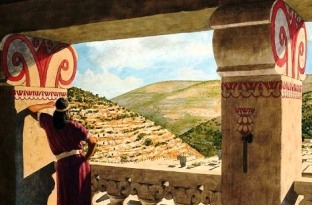
 昼寝から目覚めたダビデが王宮のバルコニーにやってきますと、水しぶきの音が聞こえてきました。目を向けますと、ある家の中庭で水を浴びている女性がいたのです・・・。ダビデがいる王宮は多くの兵士によって守られている場所で、そのバルコニーはダビデにとって最も安全な場所でした。もちろん、彼はその場所で軍服を着、剣を帯びている必要もなく、それこそガウンを羽織って気を休めることができました。しかし、その最も安全で快適な場所が一転、最も危険な場所となりました。その時、彼の心はどんな状態だったのでしょうか。そうです、私達は忘れてはなりません。ダビデも鼻から息する人間だということを。
Secure Video Sharing
マック
「礼拝プログラム」、「一日一生」はこちらから。
礼拝メッセージの音声はこちら。
本日の日英メッセージ原稿、おもちかえりはこちらから ↓
安泰な時こそ、心を主に向ける
2017年3月19日
私達は二週間前、イスラエルの初代の王、サウルがどのように失脚していったかということを見ました。彼は「鼻から息する人間」を恐れ、「神を畏れる」ことがありませんでした。これがサウルの失脚へとつながりました。私達もサウルと変わらず、とかく人を恐れるものです。しかし、私達が本来、恐れるべき唯一のお方は神なのだとこのサウルの失脚は私達に語りかけています。
先週、私達はダビデが巨人ゴリアテと恐れずに戦ったこと、自分の命を狙うサウルの息の根を止める状況にありながら彼に剣を向けることをしなかったことについてお話ししました。そして、ダビデがこの二件について神の御心にかなったことをすることができたのは、彼が「そのために予め備えていたからだ」ということをお話しました。
しかし、そんなダビデも私達と同じ「鼻から息する人間」でした。彼も人である限り、完全ではありません。彼もその生涯、いくつかの大きな失敗をしました。ダビデの失敗として私達がまず頭に思い浮かべること、そう、それはあのバテシバとの出来事です。
ダビデをつけ回したサウル王は戦死し、ダビデはイスラエルの王座につきます。神の恵みとあわれみによりイスラエルは他国との戦いの最中にありながら、その戦は勝利が続き、国も安定します。ゴリアテを倒して以来、ダビデは優れた軍人としてイスラエルの先頭に立ち、その指揮にあたってきましたが、国力が安定してきますと、特別なことがない限り、彼はエルサレムにとどまり、自分の部下が彼に代わり戦地で戦い、その戦いも順調で、穏やかな毎日を王宮で過ごしていました。
そんなある夕刻、昼寝から覚めたダビデは王宮の屋上にあがりました。心身ともにリラックスし、眼下を眺めれば一代にして自らが建てあげた城壁で囲まれた街を見下ろすことができます。エルサレムに行きますとダビデの町という遺跡が今も残っています。それはケデロンの谷に沿って作られた町で城壁で囲まれています。ここからは今日、ツアーが出ており私達はそのダビデの町に入っていくことができます。そのツアーではその遺跡の一番高い場所から谷間に下っていきます。ということは、おそらくその一番、高いところにダビデの宮殿があり、そのバルコニーで彼は眼下にある自らが建てた町を眺めることができたのでしょう。
ダビデがそこにおりますと、水しぶきの音が聞こえてきました。目を向けますと、ある家の中庭で水を浴びている女性がいたのです・・・。ダビデがいる王宮は多くの兵士によって守られている場所で、そのバルコニーはダビデにとって最も安全な場所でした。もちろん、彼はその場所で軍服を着、剣を帯びている必要もなく、それこそガウンを羽織って気を休めることができました。しかし、その最も安全で快適な場所が一転、最も危険な場所となりました。その時、彼の心はどんな状態だったのでしょうか。そうです、私達は忘れてはなりません。ダビデも鼻から息する人間だということを。
ダビデがその女について調べてみますと彼女の名前はバテシバといい、イスラエルのために戦地に行っている自分の部下、ウリヤの妻であることが分かります。しかし、ダビデはそれを知りつつも彼女を自分の所に呼び、彼女と関係をもちます。やがて彼女はダビデの子を宿していることが分かり、ダビデは自分のしたことが公にならないようあの手この手を尽くします。しかし、どれもうまくいかず、最後にダビデは自分に対して忠誠を尽くしたバテシバの夫ウリヤを戦いの最前線に送るように仕向け、彼はそこで戦死するのです。一つの罪を隠すために、別の罪が上塗りされ、転がるようにして彼は罪の奈落の底に落ちました(サムエル記下12章)。
高校時代の夏休み、私は事故を起こしました。その時、湘南海岸沿いにあるレストランでのアルバイトを終え、夜遅くバイクにまたがり、海岸線のなめらかなカーブを曲がり切れずにガードレールに衝突したのです。その時、私はバイクを運転してから半年ぐらいが経ち、そこそこ自分は運転ができる、もっと言いますと運転がうまいと思い始めていた時でした。ですから、そのカーブもかっこよく曲がれるとスピードを落とさずに曲がろうとしたところ、曲がり切れずに衝突したのです。さいわいケガはありませんでしたがスポークが曲がり、それ以上、運転ができなくなったバイクを修理するために、その夏のアルバイトで稼いだものは全て消えました。この経験ゆえに私は今でもカーブを曲がる時には必ず減速します。あの時の「しまった!」という思いと「ドキッ」とした思いが心に刻まれているからです。
私達が危機に直面している時、私達は注意深くなります。そして、その注意深さが私達を救ってくれます。しかし、私達が何の問題もない時、もっといいますと物事がとてもスムーズにいっている時、私達は注意深さを失います。油断します。傲慢になります。その時が一番、危ない時です。
中国の兵法(戦に勝つための戦略)の中に、「敵を傲慢にさせる」というのがあるそうです。確かに敵が傲慢になり始めたら、それはチャンスとなります。つけ入る余地がいくつも出てくるからです。相手は油断をするからです。注意深い備えを怠るようになるからです。バテシバの一件が起きた時、自分にも国にも危機はなく、ある意味、ダビデは人生においても公私ともに最も穏やかな日々を過ごしていたのです。しかし、それが彼にとって最も危険な時となりました。
ゴリアテの挑発に立ち向かった時、サウルの狂気から逃れようとしていた時、彼は自分の命を失いかねない状況の中におりました。そのような時にダビデは自ら備えていたものにより、勝利を得ました。しかし、平穏な日々、昼寝から目覚めた時に、水を浴びる女性を見た時に、彼が備えていたものは役に立ちませんでした。
私達はこのダビデの失敗から知恵を得ます。「困ったときの神頼み」という言葉がありますように、問題がある時、危機に直面している時、私達は神様に助けを求めます。いつもより聖書を読みます。いつもより熱心に礼拝や集会にも来ます。私達は謙虚になります。慎重になります。このような状態になりますとその問題の解決が現実的なものとなります。しかし、どうしたことでしょうか、このような問題が解決されますと、何事もなかったかのように聖書から離れ、礼拝、集会から遠ざかります。神様がどんどん、その優先順位から離れていきます。
そうです、その時、私達は思うのです。「自分の問題は解決されたのだ。もう、大丈夫だ」。ところがどっこい、私達が今日、ダビデから学ぶことは私達は問題が何もない時にこそ、しっかりと主につながっていなければならないということなのです。この安泰な日々の中で起こしてしまったダビデの問題は小さなことではありません。それは人の命を殺めるというところまでいった問題です。それは危機の中で起きたのではなく、穏やかで平和な夕暮れに起きたのです。
アダムとエバもそうでした。彼らは何不自由なく、痛みも悲しみもない完璧な環境の中であの禁じられた実を食べました。そして、その影響たるや今日、私達はその時から人類に入ってきました罪の力に飲み込まれてしまうような世界に暮らしているのです。
もう一度、申し上げます。ですから、そのような平穏無事な時にこそ、私達は主につながっていなければなりません。危機の時の問題はそこに思いが集中して向けられますから解決しやすいものです。しかし、危機ではない時に起きていた問題は、それに気がつくことが遅く、根深く、解決が難しいことがしばしばあるのです。
ダビデは姦淫、虚偽、殺人の罪を犯しました。彼は権威をもった王ですから、その力により、自分の不祥事をもみ消すことができたでしょう。しかし、人を騙し、人を黙らせることができても、神様は全てお見通しです。神様は預言者ナタンを彼のもとに送り、ナタンは彼のなしたことが神の前においてどんなに大きな罪であるかを臆せずにダビデに指摘します。
ダビデはその場でナタンを捕らえ、獄につなぐこともできたでしょう。おそらく、当時の多くの王達は皆、罪の責めを感じることなく、そのようにしてこのようなことも何事もなかったようにしていたことでしょう。しかし、ダビデは違いました。
ダビデはその時、自分に向き合いました。そして、神にしがみつきました。彼はナタンの指摘の前に砕かれて、ひれ伏し、このような歌を歌いました。
1そのとががゆるされ、その罪がおおい消される者はさいわいである。2主によって不義を負わされず、その霊に偽りのない人はさいわいである。3わたしが自分の罪を言いあらわさなかった時は、ひねもす苦しみうめいたので、わたしの骨はふるび衰えた。4あなたのみ手が昼も夜も、わたしの上に重かったからである。わたしの力は、夏のひでりによってかれるように、かれ果てた。5わたしは自分の罪をあなたに知らせ、自分の不義を隠さなかった。わたしは言った、「わたしのとがを主に告白しよう」と。その時あなたはわたしの犯した罪をゆるされた(詩篇32篇1節‐5節)。
ダビデは自分がしてしまったことを自覚していました。そして、その罪を心に持ち続けている時の彼の心について彼はこのように書いています『3わたしが自分の罪を言いあらわさなかった時は、ひねもす苦しみうめいたので、わたしの骨はふるび衰えた。4あなたのみ手が昼も夜も、わたしの上に重かったからである。わたしの力は、夏のひでりによってかれるように、かれ果てた』。「自分の罪を言い表さなかった時」とはまさしくナタンに全てを指摘される前、あの手、この手でこの自分の罪を隠し通そうとしていた時であり、その時、彼はひめもす苦しみうめき、その骨が古び衰えたというのです。私は渇きましたどころではない、ダビデは枯れ果てたのです。
主にある皆さん、このような状態で毎日を過ごすということ、それはなんと苦しいことでしょうか。豊かさと力を甘受しながらも、このような心の状態である限り、その人は決して心が満たされ、再び平安に導かれることはないでしょう。
ダビデがしてしまったことに関して、それはまさしく「魔が差す」という言葉が一番、ぴったりくるのかもしれません。魔といえば私達はまず「悪魔」を思い起こします。「悪の力」を思います。確かにその時、ダビデは魔がさしたのですが、彼はその魔は「サタンによるもの、悪の力によるもの」とは言いませんでした。彼はそれは「自分がしてしまったこと」としたのです。
私達はしばしば、このような時に、それは「悪の力の仕業だ」といいます。しかし、そのような時に私達は「悪の力の仕業」というところに結びつける前に、まず一番最初に「自分に問題はなかったのか」ということを省みる省べきです。そして、次に「そのことに関わっている人達はどうか」ということを省み、さらに諸々のことを省み、それらの後「そこには悪の力がはたらいていたのか」ということを思うべきでしょう。
最初から「それは悪の力です。ピリオド」にしたら、私達は自らを省みて、そこから学ぶことをせず、同じような問題が起きます。そして、その度に問題を悪の力のせいにしておりますと、その問題は未解決ですから、ますます大きなものとなります。このことについて微笑んでいるのはまさしく、その悪の力です。普通は自分が関わっていないことをお前のせいだといわれることは嫌なことですが、人が自分のせいにし、それゆえにその問題の原因を見極めることができずに、問題がさらに深刻になっていくということになれば、まさしく、その悪の力はたいそう喜んでいることでしょう。
ダビデは自らの罪を認め、彼は神にしがみつきました。詩篇51篇はダビデが作ったものですが、聖書はわざわざ、こんな添え書きをしています。「聖歌隊の指揮者によって歌わせたダビデの歌。これはダビデがバテシバに通った後、預言者ナタンがきた時に歌ったもの」。そう、もはや彼がしたことは天下にあまねく知られ、彼はそのことを自覚し、鼻から息する者としてこんな歌を歌いました。
1 神よ、あなたのいつくしみによって、わたしをあわれみ、あなたの豊かなあわれみによって、わたしのもろもろのとがをぬぐい去ってください。2 わたしの不義をことごとく洗い去り、わたしの罪からわたしを清めてください。 3わたしは自分のとがを知っています。わたしの罪はいつもわたしの前にあります。 4わたしはあなたにむかい、ただあなたに罪を犯し、あなたの前に悪い事を行いました。それゆえ、あなたが宣告をお与えになるときは正しく、あなたが人をさばかれるときは誤りがありません・・・。・・・14神よ、わが救の神よ、血を流した罪からわたしを助け出してください。わたしの舌は声高らかにあなたの義を歌うでしょう。 15 主よ、わたしのくちびるを開いてください。わたしの口はあなたの誉をあらわすでしょう。 16あなたはいけにえを好まれません。たといわたしが燔祭をささげてもあなたは喜ばれないでしょう。 17 神の受けられるいけにえは砕けた魂です。神よ、あなたは砕けた悔いた心をかろしめられません。
主にある兄弟姉妹。私達も鼻から息する者です。鼻から息する者であるゆえに、ダビデのように罪を犯すものなのです。そして、その罪を私達は自ら償うことなどできないのです。ダビデもそうでした。ですから、彼は神にその赦しを求めたのです。
私達は来月、イースターを迎えます。イースターの喜びの前に私達は十字架があったことを私達は知らなければなりません。十字架とは何ですか。十字架とは我々が償うことができない罪に対する罰をキリストが全て身代わりとして受けてくださったことです。私達にはもはやどうすることもできない、解決不可能な罪に対して、その十字架ゆえに我々はその罪から赦されると聖書は語り続けています。
ある方は思います。自分がしてしまった、あのこと、このことは、いくら神でもどうすることもできないだろう。いいえ、神の愛は私達がしてしまったことよりもはるかに大きなものです。神の愛と赦しが包み込むことのできない罪はないのです。ただ私達に必要なものはダビデがその最後に言っている私達の心です。
16あなたはいけにえを好まれません。たといわたしが燔祭をささげてもあなたは喜ばれないでしょう。 17 神の受けられるいけにえは砕けた魂です。神よ、あなたは砕けた悔いた心をかろしめられません。
私達が自分の罪の償いとして、神の前に捧げものを持参しても神はそれを喜ばれることはありません。そもそも、罪とはそのような捧げものと交換して赦されうるようなものではないのです。神が私達に願うことは、我々の砕けた魂であり、我々の悔いた心です。その心をもってキリストの十字架の前に一人、出よと聖書は言うのです。
詩篇116篇10節には「わたしは大いに悩んだと言った時にもなお信じた」という言葉がありますが、まさしくダビデは大いに悩んだ時にも、なお神様に対する信仰を持ち続けたのです。その心境たるや、自らがしてしまったことに対する骨が古び衰えるような絶望感でありました。しかし、そのような大きな悩みが彼を襲ってきても、彼はなお神を信じたのです。さらにさらに大きな大きな悩みが彼を襲ってきても、彼はなおもなおも神を信じたのです!
私達もダビデと同じ鼻から息する者です。事の大小、その内容は異なるでしょうが、ダビデと同じように私達の砕けた魂を、砕けた悔いた心をキリストの十字架の前に持っていこうではありませんか。自らのいたらなさ、自らの罪、それらに大いに悩むような時があって、それでも神の愛と赦しを信じ続けようではありませんか。もし、私達の愛する者が深く罪に陥ってしまっていたとしたら、彼らのその罪をも包み込む、神の愛が彼らに届くことができるように、彼らの心が砕かれ、神に近づくことができるように祈ろうではありませんか。
最後にヘブル人の手紙10章38節-39節を読んでこのメッセージを終えます。「我が義人は信仰によって生きる。もし信仰を捨てるなら、わたしの魂はこれを喜ばない。しかし私達は信仰を捨てて滅びる者ではなく、信仰に立って、命を得る者である」私達は鼻から息する自分を完全に信じることはできません。しかし、私達は2000年前に私達のためにカルバリの十字架で血を流してくださったイエス・キリストの愛を信じます。その信仰に立ち続け、命を得ることができる者とされているということを信じます。私達は信仰を捨てて滅びる者ではなく、信仰に立ち続け、命を得る者です。お祈りしましょう。
Turning to God especially in a time of Peace
March 19, 2017
Two weeks ago we studied the downfall of the first king of Israel, Saul. Saul feared “humans who have but a breath in their nostrils” but didn’t “fear the Lord.” This led to his downfall. Like Saul, we too are apt to fear humans. However, Saul’s downfall tells us that God should be the only one we should naturally fear.
Last week we talked about how David fought the giant Goliath without fear, and how he didn’t thrust his spear through Saul even though he was in a situation to kill Saul who was after his life. We concluded that the reason why David was able to do God’s will, regarding these two situations, was because he had “previously prepared for that day.”
David was a “human who had but a breath in his nostrils,” just like us; and as long as he was a human being, he was not perfect. David made a few big mistakes in his lifetime. The first thing that comes to mind when thinking about David’s mistakes is that incident with Bathsheba.
After King Saul, who was chasing after David, dies in battle, David sits on the throne as Israel’s ruler. Through God’s grace and mercy, even in the midst of war, Israel experiences a succession of victories, leading to stabilization. Ever since defeating Goliath, David stood in the front lines as a distinguished soldier, commanding others. As the country stabilized, David would stay in Jerusalem and spend peaceful days at the palace unless under special circumstances that required him on the field. His soldiers went to battle instead of David and these battles too would go smoothly.
One evening, waking up from a midday nap, David went to the roof of his palace. In a state of relaxation of both mind and body, David looked down at the city and the surrounding walls he built up in his generation. When you visit Jerusalem, the ruins of the City of David remain even until this day. The City of David is built along the Kidron Valley and is surrounded by city walls. There’s actually a tour that shows you around the City. That tour starts off at the highest point of the ruins then goes down into the valley; which means that the highest point where the tour started was where David’s palace was at, and from his balcony he was looking at the city below him.
As he looks out over the city he hears water. As he glances over, he notices a woman taking a bath in a courtyard. David’s palace was a safe place protected by many soldiers. So for David, the balcony was the safest place for him to be. He certainly didn’t have to wear his military uniform or have a sword by his side; He was able to be in his robe and relax. But this most safe and pleasant place all of a sudden became the most dangerous place. I wonder what state his heart was in at that moment. Yes, we cannot forget that David too was a human who have but a breath in his nostrils.
When David sent someone to find out who this woman was, he learns that her name was Bathsheba and that she was the wife of one of his soldiers Uriah, who was out in the fields fighting for Israel. David knew this, yet called her to his palace and sleeps with her. Later, Bathsheba discovers that she is pregnant and David tries every possible method to cover up what he had done. But all his methods fail and so he has Uriah, Bathsheba’s husband, who has only ever been loyal to him assigned to the front lines where the battle was fiercest. There Uriah was killed in battle. To hide the first, one sin led to the next and this is how David fell into the bottomless pit of sin (2 Samuel 12).
One summer night when I was in high school, I got in an accident. I had just finished my part-time job at a restaurant by the Shonan coast and was riding my motorcycle along the smooth coastline but couldn’t make the turn and ran into the guardrail. It was about 6 months since I started riding my bike, so I had started to think I was good at riding a motorcycle. I thought that I could make the turn all cool without slowing down, but I was wrong; I wasn’t able to make the turn and ended up crashing. Luckily I wasn’t hurt but my spoked wheel was bent and I could no longer ride my bike, so all that I’ve earned that summer went towards fixing it. Because of this experience, even until this day, when I take a curb I always slow down. It’s because that feeling of my heart jumping and thinking “oh shoot!” was etched into my heart.
When we face a crisis we become cautious. That caution saves us. But when we don’t face any problems, actually, when things are going very smoothly, our guards are down. We become too relaxed. We are even arrogant. And that’s when we’re most at risk.
There’s a Chinese tactic/strategy where you try to make your “enemies feel arrogant.” When your enemy starts becoming arrogant, you certainly have many opportunities to take advantage. It’s because they put their guard down, neglecting their cautious defense. When that affair with Bathsheba took place, David nor Israel were in a crisis. Actually, David’s private and public life were both very peaceful during this time. But this put him at extreme risk.
When David faced the challenge of Goliath and was fleeing from Saul’s madness, he was in a situation where he could lose his life. In those times, David was able to win because he was prepared. However, all that he was equipped with was useless when he was living in those peaceful days, waking up from a nap and seeing a woman bathing.
We gain wisdom from this failure of David. As the saying “one will pray to the gods in extremity” we seek God’s help when we are facing a problem or crisis. We read the bible more than usual. We attend services or attend meetings more studiously. We become humble and cautious. In these kinds of situations, the solution to the problem becomes realistic. And when our problems are solved, we leave the bible, services and meetings, as if nothing happened. God becomes less and less of a priority.
That’s when we think, “My problem’s solved, I’m safe now.” But the funny thing is, what we learn from David today is that, we have to stay closely connected to the Lord all the more when facing no problems. This problem of David, which occurred in a time of peace, was no small problem. It was a problem that led to a man’s death; and remember, this didn’t happen in a time of crisis, but in a calm and peaceful evening.
It was the same with Adam and Eve. They lived comfortably in a perfect environment without pain or grief when they ate the forbidden fruit. Speaking of the impact that this has on us today, we live in a world where the power of sin is so great it almost swallows us in.
I say it again. That is why we need to stay connected to the Lord all the more when we are living in a time of peace and tranquility. In a time of crisis, our thoughts are focused on the problem, that’s why these problems tend to be solved much quicker. But frequently, the problems that occur outside of a crisis tend to be last-noticed, deep-rooted and difficult to solve.
The sins David committed were: adultery, deceit and murder. Being a powerful king, I’m sure David was able to hide his scandal under his power. But even if you succeed in deceiving or silencing people, God sees everything. God sends Nathan the prophet to rebuke David for what a great sin he had committed before the Lord.
David could have captured Nathan right then and there and sent him to prison. Many kings in those days didn’t feel responsible for their sins and probably did just that, as if nothing happened. But David was different.
David was true to himself and clung to the Lord. He broke down before Nathan, confessed his sins and sang a song like this:
Blessed is the one whose transgressions are forgiven, whose sins are covered. Blessed is the one whose sin the Lord does not count against them and in whose spirit is no deceit. When I kept silent, my bones wasted away through my groaning all day long. For day and night your hand was heavy on me; my strength was sapped as in the heat of summer. Then I acknowledged my sin to you and did not cover up my iniquity. I said, “I will confess my transgressions to the Lord.” And you forgave the guilt of my sin. (Psalm 32:1-5)
David realizes what a sin he had committed, and writes about his days when he kept the sin in his heart: “When I kept silent, my bones wasted away through my groaning all day long. For day and night your hand was heavy on me; my strength was sapped as in the heat of summer.” “When I kept silent” undoubtedly pointed to the time before Nathan rebuked David. When David refused to confess his sin, he said he was weak and miserable, groaning all day long. In fact, he didn’t say he was dry or thirsty; he said he was withered completely.
How painful must it had been to be in such a condition day after day. No matter how abundant your life is and how much power you have, as long as you’re in such a state, no one will be able to satisfy their hearts nor could they feel peace again.
What David had done could be described perfectly with the phrase, “tempted by an evil spirit.” We first think of “Satan” when we think of the word “evil spirit.” We also think of “the power of the devil.” At that time, David indeed was possessed by an evil spirit but he didn’t say the evil was “done by Satan or the power of the devil.” He said it was “something he had done.”
In these situations, we oftentimes say “it’s the power of the devil.” But before we link our doing to “the power of the devil” the very first thing we need to reflect on is ourselves by asking “was there a problem with me?” Next, we need to reflect on “those who were involved” and then further reflect on various things, then after all that can we only think “if the power of the devil was at work.”
If from the start we say, “it was the devil’s work, period” we will never reflect on ourselves and learn from these mistakes which will lead to similar problems in the future. If we blame our problems on “the power of the devil” our problems will grow bigger and bigger because they are untreated. And who do you think is smiling at this? The devil. Normally, it’s undesirable to be blamed about something you had nothing to do with. But what if you’re unable to find the cause of the problem, because you blame the devil, and the problem gets worse and worse; the devil surely must be rejoicing triumphantly.
David admitted his sin himself, and tightly held onto God. Psalm 51 is written by David, but the bible consciously notes: “For the director of music. A psalm of David. When the prophet Nathan came to him after David had committed adultery with Bathsheba.” What David had done was known throughout the country. He admits his faults. Then as a man who have but a breath in his nostrils, sings this song:
Have mercy on me, O God, according to your unfailing love; according to your great compassion blot out my transgressions. Wash away all my iniquity and cleanse me from my sin. For I know my transgressions, and my sin is always before me. Against you, you only, have I sinned and done what is evil in your sight; so you are right in your verdict and justified when you judge… Deliver me from the guilt of bloodshed, O God, you who are God my Savior, and my tongue will sing of your righteousness. Open my lips, Lord, and my mouth will declare your praise. You do not delight in sacrifice, or I would bring it; you do not take pleasure in burnt offerings. My sacrifice, O God, is a broken spirit; a broken and contrite heart you, God, will not despise.
Dear brothers and sisters, we have but a breath in our nostrils. But because we have but a breath in our nostrils, we commit sins like David. And we as humans, cannot redeem our sins ourselves. It was the same with David. That is why David sought forgiveness from the Lord.
Easter is coming up next month. But before the joy of Easter we have to know the true meaning of the cross. What was the cross? The cross was a place where Jesus took on the penalty of our sins, the sins that we ourselves cannot redeem. Throughout the bible it tells us that we are forgiven and freed from our unsolvable sins because of the cross.
You may think, God can’t do anything about the things I’ve done. I’m sorry but you’re wrong, because God’s love is far deeper than anything we have ever done. There is no sin that God’s love and forgiveness cannot pardon. All we need is what David tells us at the end of his song, a broken spirit.
You do not delight in sacrifice, or I would bring it; you do not take pleasure in burnt offerings. My sacrifice, O God, is a broken spirit; a broken and contrite heart you, God, will not despise.
The Lord doesn’t delight in sacrifices to make up for our sins. Sins cannot be forgiven by something like sacrifices to begin with. What the Lord wants from us is a broken spirit, a broken and contrite heart. And the bible tells us to take that broken spirit and stand before the cross where Jesus died for our sins.
Psalm 116:10 says “I trust in the Lord when I said, ‘I am greatly afflicted.’” David certainly continued to trust in the Lord when he was deeply troubled. Speaking of his state of mind, he was in deep despair, despair that made him weak and miserable. But no matter how weak and miserable he was feeling, he trusted the Lord. Furthermore, no matter how big of a suffering came along, he still continued to trust in the Lord.
Just like David, we are humans who have but a breath in our nostrils. Whether it may differ in size or content, let us, as David did, bring our broken spirit, and our broken and repentant heart before Christ who died on the cross. Let us continue to trust in the love and forgiveness of our Lord even when we are greatly distressed in our faults and sins. And if our loved ones have deeply sunk into sin, let us pray that their spirits will break, so that they can come back to the Lord and experience His love that will pardon their sins.
I would like to end this message with a passage from Hebrews 10:38-39. “But my righteous one will live by faith. And I take no pleasure in the one who shrinks back. But we do not belong to those who shrink back and are destroyed, but to those who have faith and are saved.” As humans who have but a breath in our nostrils, we cannot completely trust ourselves. But we are able to place trust in the love of Jesus Christ who shed his blood on the cross at Calvary for us 2000 years ago. We believe that we are those who continue to have faith and are saved. We are not like those who turn our backs on God and seal our fate because we have faith that assures our salvation.
Let us pray.
Translated by Naomi Vogt and read by Shirah Vogt
本日のおもちかえり
2017年3月19日
1)サムエル記下11章を読みましょう。ダビデがしたことは何ですか。このことによりダビデはどんな罪を犯しましたか。なぜ、ダビデのような信仰深い人がこのようなことを引き起こしたと思いますか。
2)この時、ダビデには大きな試みはなく、公私ともに平穏無事でした。なぜ、そのような時にこの問題は起きたのですか。ここから私達が学ぶべきことは何でしょうか。
3)物事が全てうまくいっている時、私達はどんな心をもつ傾向がありますか。
4)ダビデの部下、ナタンはダビデの罪を指摘しました。それに対してダビデは詩篇32篇1節‐5節の言葉を残しました。自らの罪を包み隠そうとする時に、大きな苦しみを私達は抱え込みます。その苦しみをダビデはどのように表現していますか。
5)私達が身の回りの問題を見渡す時、そこには人の罪がどのように関係していますか。
6)ダビデは直面している問題の原因を「悪の力」によるものとはせずに、「自分の罪」として認めました。なぜ、このことは大切ですか(問題の解決に不可欠なことは、その原因を突き止めることです)。
7)ナタンから罪を指摘された時に、ダビデは詩篇51篇にその時の心境を記しています。このところでダビデは神は私達にどんな心を求めていることが分かりますか。
8)主イエス・キリストの十字架によって赦されない罪がありますか。神の愛では贖いきれない罪というものがありますか。
